$2.60
Speckled Alder 36″ fresh cut live stakes 100 minimum order required.
100 or more $2.60 each
300 or more $2.40 each
1,000 or more call 443-831-2986
Description
Speckled Alder is an excellent bioengineering plant for mitigation projects, streambank restoration, erosion / sediment control and other types of planting or mitigation projects.
They are commonly used as a live stake for streambank restoration since they can be easily installed without the need to excavate. A small pilot hole made with a rebar is made or the stake is merely pushed into the soft ground as shown in the drawing below.
We offer many native species of Willows, Dogwoods, Alder, Buttonbush, Arrowwood Viburnum, Elderberry, and Sycamore. We do not sell non native invasive species like other competitors.
We want you to have the best results possible so, as with all our plant offerings, we provide the cultural requirements of each species in the information portion for that species, allowing you to select the correct plants for your project.
We freshly cut to order all of our live stakes, fascines, and brush layering. Many of our competitors store their live stakes long term which greatly degrades the viability and quality. We cut your order and it is shipped out the same day or at most within 1-2 days assuring the best possible results.
Bioengineering plants can be shipped via UPS ground for orders under 1,000 pieces. Larger volume orders are often sent LTL via Ward or Estes or in some case delivered on our own trucks. Contact us for details.
Freshly cut to order Alnus incana rugosa live stakes.
Alnus incana (L.) Moench ssp. rugosa (Du Roi) R.T. Clausen
Speckled Alder, Gray Alder, Hoary Alder, Swamp Alder
Betulaceae (Birch Family)
Synonym(s): Alnus incana var. americana, Alnus rugosa, Alnus rugosa var. americana
USDA Symbol: alinr
USDA Native Status: L48 (N), CAN (N), SPM (N)
A low and clump-forming shrub; sometimes a small tree. Height: 20 to 30 feet.
The Latin subspecies name, meaning “rugose” or “wrinkled,” refers to the network of sunken veins prominent on the lower leaf surfaces
Plant Characteristics
Duration: Perennial
Habit: Shrub , Tree
Leaf Retention: Deciduous
Leaf Arrangement: Alternate
Leaf Complexity: Simple
Leaf Venation: Pinnate
Breeding System: Flowers Unisexual , Monoecious
Fruit Type: Samara
Size Notes: Height: 6-9 meters. The eastern subspecies, Alnus incana ssp. rugosa, grows as a large shrub and may reach 9 meters in height.
Leaf: Dark Green.
Fruit: Green.
Bloom Information
Bloom Color: Yellow , Green , Brown
Bloom Time: Apr , May
Distribution
USA: CT , IA , IL , IN , MA , MD , ME , MI , MN , ND , NH , NJ , NY , OH , PA , RI , VA , VT , WI , WV
Canada: MB , NB , NL , NS , ON , PE , QC , SK
Native Distribution: Northeastern US and eastern Canada, south to Virginia and west to North Dakota and Saskatchewan. (webref:27).
Native Habitat: “Stream banks, lake shores, bogs, swamps, margins of wet fields, swales, and roadsides, often forming dense thickets; 0–800 m.” (webref:38).
Growing Conditions
Water Use: Medium
Light Requirement: Sun , Part Shade , Shade
Soil Moisture: Moist
CaCO3 Tolerance: Medium
Conditions Comments: Nitrogen fixing using root nodules
Benefit
Use Ornamental: Planted as an ornamental at water edges.
Use Wildlife: Alder thickets provide cover for wildlife, browse for deer and moose.
Use Medicinal: Bark was reportedly boiled to make medicinal teas for treating rheumatism and also applied to wounds as a poultice to reduce bleeding and swelling.
Use Other: Inuit people and settlers extracted a dark dye from the bark for tanning and staining hides.
Interesting Foliage: yes
Attracts: Butterflies
Larval Host: Green Comma butterfly
Butterflies and Moths of North America (BAMONA)
Green Comma
(Polygonia faunus)
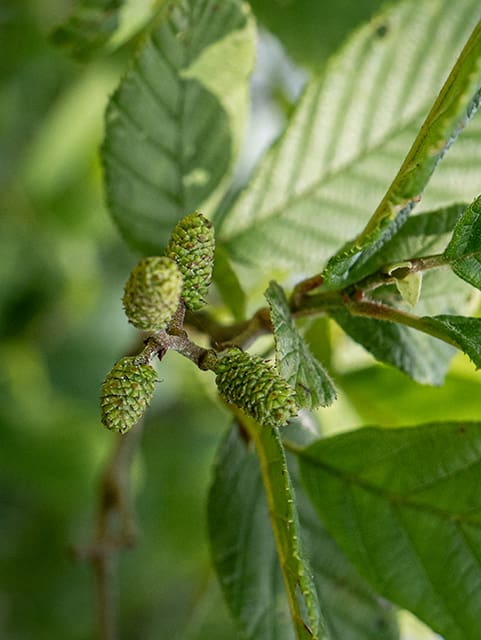
Speckled Alder, Alnus incana, is a deciduous shrub or small tree native to North America. It is commonly found in wetland areas, such as swamps, bogs, and along stream banks.
Speckled Alder is known for its unique bark, which is smooth and grayish-brown with white speckles or lenticels. The leaves are oval-shaped and serrated, with a dark green color that turns yellow in the fall. It produces small, inconspicuous flowers in the spring, followed by small cone-like fruits.
This species is well-adapted to wet and poorly drained soils, making it an excellent choice for wetland restoration or rain gardens. It can also tolerate some drought once established. Speckled Alder prefers full sun to partial shade for optimal growth.
Related products
-

Salix interior Sandbar Willow 18″ Live Stakes for Erosion Control
$1.45 Add to cart -
Cornus sericea, Redosier Dogwood 18″ FRESHLY cut to order Live Stakes, Live stake for Erosion Control
$1.45 Add to cart -
Cephalanthus occidentalis Buttonbush 18″ FRESHLY cut to order Live Stakes Native Live Stakes For Erosion Control
$1.45 Add to cart -
Salix nigra, Black willow 12″ FRESHLY cut to order Live Stakes, Live stakes for Erosion Control
$1.15 Add to cart