$8.00
Carya illinoinensis, Pecan, 12-18″ Wholesale Native Bare Root Trees
Wholesale Native Bare Root Trees
for sale Wholesale Pricing is based on quantity.
An order minimum/multiples of 25 of this size/species is required.
5 or more $8.00 each
25 or more $3.00 each
50 or more $1.75 each
300 or more $1.65 each
1000 or more $1.55 each
Check the native status of this species for your area: https://plants.usda.gov/plant-profile/CAIL2
For Shipping, Install and additional info please see “About Bare Root“.
Native bare Root Trees are dug and shipped while dormant, late November to early spring.
See all available native Bare Root Trees
The NOT Fine Print
Unless otherwise indicated, there is a minimum order total of $150.00.
before tax (VA residents only) and shipping.
Before you order:
Please be assured that our goal as native plant growers with over 45 years of experience, is to support the intention and needs of our customers. Whether you are an industry professional or home conservationist, or if you just like GREAT plants! We want your return business!
We are always available to answer questions about a plant's cultural needs or to assist our customers with any questions to make working with Mid Atlantic Natives a superior experience. To do this, we cannot stress enough the importance of selecting the right species for your application and environment. Each plant species has detailed information for its suitable, preferred environment (Sun, wet, dry, acidic, etc.) We provide this information so you can make the best selections and have the best results. (as in, I planted a water plant in a desert dune and don't know why it died!!)
Before selecting plants, please ask yourself:
Are the site conditions correct for the species you select? Do you know how to correctly plant? Are you able to provide the aftercare needed?
It is important to us that you are successful with your investment. We would rather not sell our plants then have a dissatisfied, unprepared customer or, equally as upsetting to us, any plant mortality.
Because we have no control over how plants are handled after they are shipped, or of any element of a planting project from design to installation, we cannot offer any guarantees of plant survival. Please make sure you select plant material suitable for your project’s conditions and environment. All Sales Are Final
We are careful to keep varieties true to name, but mistakes sometimes happen. It is mutually agreed that our liability for any errors is confined to replacement with correct species or, if not available, credit of the purchase price.
In the event of an incorrect count we will send the missing items. There is no opportunity for a credit unless those items are not available. The credit will be for the missing amount only.
Cancellations
Orders already DUG, but not yet shipped, will not be refunded. If an order is canceled after payment has been received, we reserve the right to charge a 50% re-stocking fee. We will charge a 6% Credit Card transaction fee to recover what we are charged by credit card companies for placing and refunding your order. Deposits (WHOLESALE orders of $8,000.00 or more ONLY) on "special orders" are not refundable.
If your order must be cancelled because a requested ship date is entered outside of the posted available dates entered, or you did not read the shipping time frames for a particular species or group (I.E. Bare Root/Plugs, Live Stakes), there will be a 10% cancellation fee.
Damage
Because of the type of packaging and custom-designed box style we use, shipping issues are rare. If there is a problem with your purchased items, it must be reported to us within 72 hours of receipt. Photos of the shipping materials and plants will be requested.
Claims resulting from carrier issues will result in your order being replaced or refunded once the claim is settled with the carrier.
Please report any other problems immediately, and we will make every effort to resolve any issues to your satisfaction. Under no circumstances will the claim amount exceed the order amount.
Inspections
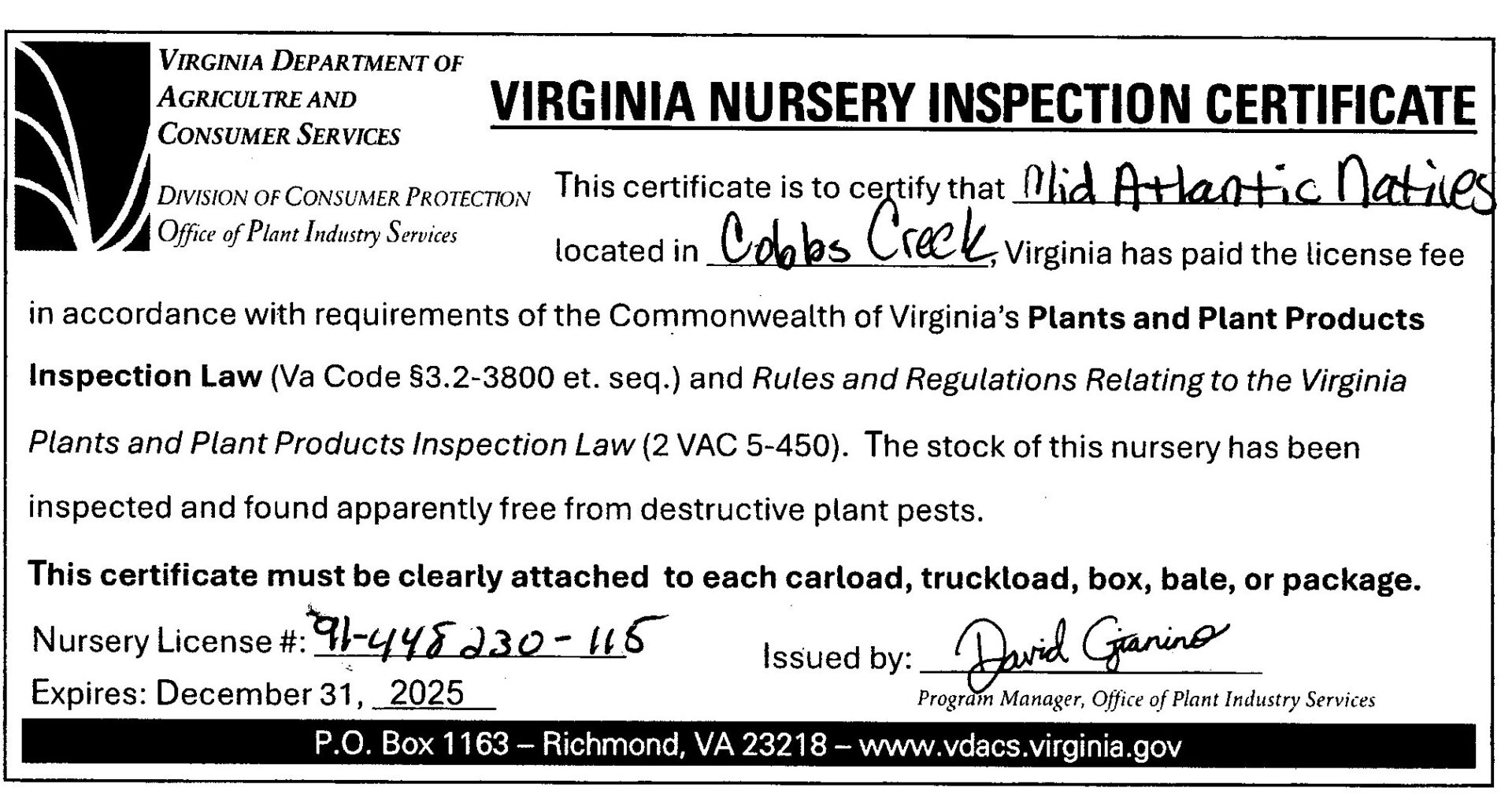
Our nursery stock has been inspected by the Virginia Department of Agriculture. Your order will be shipped with a VA Nursery Inspection certificate. A copy of our current nursery certificate is here.
Need more "Not So Fine Print"? We hope you do! For fun, and because you have to agree to it, please read our full "Terms and Conditions".
Description
Carya illinoinensis, Pecan, 12-18″ Wholesale Native Bare Root Trees
An order minimum/multiples of 5 of this size/species is required.
USDA Symbol: cail2
USDA Native Status: L48 (N)
Breeding System: Flowers Unisexual , Monoecious
Fruit Type: Nut
Size Notes: Up to about 160 feet.
Leaf: Yellow-Green
Bloom Information
Bloom Color: Yellow
Bloom Time: Mar , Apr , May
Distribution
USA: AL , AR , FL , GA , IA , IL , IN , KS , KY , LA , MD , MO , MS , NC , OH , OK , SC , TN , TX , VA
Native Distribution: AL to TX, n. to OH, s.e. IN, IL, s.e. IA & s.e. KS
Native Habitat: Wooded bottomlands; stream banks
Growing Conditions
Water Use: High
Light Requirement: Sun
Soil Moisture: Moist
CaCO3 Tolerance: Low
Cold Tolerant: yes
Soil Description: Rich, moist, well-drained soils. Sandy, Sandy Loam, Medium Loam, Clay Loam, Clay, Caliche typeConditions Comments: The sweet, edible nut, makes pecan the best hickory for fruit production.
Native American Use and Cultivation:
Food Source:
Pecans were a crucial food source for various tribes, providing sustenance during fall and winter. The nuts were consumed fresh, stored for later use, and also used to create pecan milk by grinding the nuts into a meal and adding water.
Hunting Aid:
Native Americans recognized that the pecan harvest attracted wildlife, making them strategic locations for hunting deer, ducks, and other animals.
Range Expansion:
Native Americans likely aided in the spread of pecan trees by planting them, particularly along riverbanks, including the Mississippi River.
Medicinal Uses:
Some tribes used pecan paste, oil, or leaf/bark infusions to treat various ailments, including intestinal worms, skin eruptions, and colds.
Cultural Significance: Extreme. Please take time to research and learn about the importance of this tree for native peoples.
Benefit
Use Ornamental: Excellent nut and shade tree, fall conspicuous.
Use Wildlife: Fruit mammals and birds, Substrate-insectivorous birds.
Use Food: Fruits-nutrition
Use Other: Furniture, veneer for wood paneling, charcoal.
Interesting Foliage: yes
Attracts: Butterflies
Larval Host: Gray hairstreak butterfly
Butterflies and Moths of North America (BAMONA)
Gray Hairstreak
(Strymon melinus)
Native American Use and Cultivation:
Food Source:
Pecans were a crucial food source for various tribes, providing sustenance during fall and winter. The nuts were consumed fresh, stored for later use, and also used to create pecan milk by grinding the nuts into a meal and adding water.
Hunting Aid:
Native Americans recognized that the pecan harvest attracted wildlife, making them strategic locations for hunting deer, ducks, and other animals.
Range Expansion:
Native Americans likely aided in the spread of pecan trees by planting them, particularly along riverbanks, including the Mississippi River.
Medicinal Uses:
Some tribes used pecan paste, oil, or leaf/bark infusions to treat various ailments, including intestinal worms, skin eruptions, and colds.
Cultural Significance:
Pecan groves were often cleared of competing vegetation by Native Americans to promote growth, and some tribes may have even managed and tended these groves.
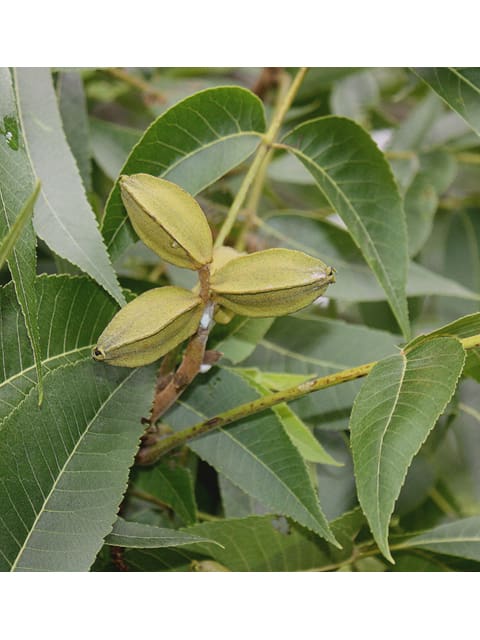
The largest of the hickories, pecan typically grows 70-100 ft. and can reach 160 ft. It is massive-trunked, with stout branches supporting a symmetrical, oval crown. Slate gray bark remains smooth for years. Pinnately-compound, deciduous leaves are 12-20 in. long with 11-17 leaflets. Midrib of the leaflet off center with the wider part of the blade toward the leaf tip. Flowers inconspicuous, male in elongate clusters, both sexes on same tree. Fruit an oblong nut enclosed in a thin husk splitting open at maturity, husk often persistent on the tree for weeks after the nut has fallen.
Pecan is one of the most valuable cultivated plants originating in North America. Improved varieties with large, thin-shelled nuts are grown in plantations or orchards in the Southeast; pecans are also harvested locally from wild trees. The wood is used for furniture, flooring, veneer, and charcoal for smoking meats. The word pecan is of Algonquin origin. The Latin species name is from an old term, “Illinois nuts,” and refers to the region where traders found wild trees and nuts. Native Americans may have extended the range by planting. This tree of the Mississippi valley was unknown to British colonists on the Atlantic coast. Thomas Jefferson planted seeds at Monticello and gave some to George Washington; now these Pecans are the oldest trees in Mount Vernon.
Carya illinoinensis, Pecan, 12-18″ Wholesale Native Bare Root Trees
Wholesale Native Bare Root Trees
for sale Wholesale Pricing is based on quantity.
An order minimum/multiples of 5 of this size/species is required.
5 or more $8.00 each
25 or more $3.00 each
50 or more $1.75 each
300 or more $1.65 each
1000 or more $1.55 each
Check the native status of this species for your area: https://plants.usda.gov/plant-profile/CAIL2
For Shipping, Install and additional info please see “About Bare Root“.
Native bare Root Trees are dug and shipped while dormant, late November to early spring.
See all available native Bare Root Trees
Related products
-

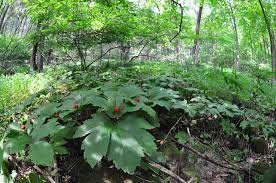
Hydrastis canadensis, Goldenseal, Wholesale Native Bare Root Perennial, Groundcover
$8.00 Add to cart -
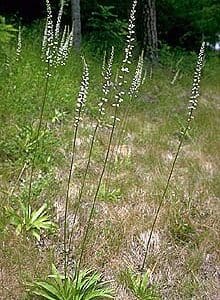
Aletris farinosa, Unicorn Root, Wholesale Native Bare Root Perennials
$8.00 Add to cart -
Asarum arifolium (Hexastylis arifolia), Evergreen Ginger, Little Brown Jug, Wholesale Native Bare Root Perennials
$3.50 Add to cart -
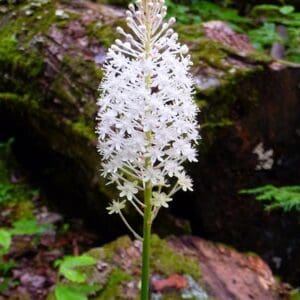
Amianthium muscitoxicum, Fly Poison, Wholesale Native Bare Root Perennial
$10.00 Add to cart